Thursday, 23 June 2011

Lia Suhn Hao-y (Goodbye) Cambodia

Well after a rather hectic time in Siem Reap visiting the ancient temples of Angkor, we thought perhaps it was time for another boat trip so we headed off to Battambang via the Siem Reap River, across the western side of Tonle Sap Lake and up the Stung Sangke River. The ferry was an over sized longtail and could be described as a water version of a local bus as it stopped wherever anyone wanted to get on or off. In this country it’s possible as there are whole villages located on the water (called floating villages), even the schools are floating. The 5hr trip took 9hrs as the river was below the normal levels required for the larger faster vessel and the boat was pretty full of passengers. We only had 1 ‘rice’ stop which was unusual as normally the buses stop for rice top ups every 2 hrs. The locals here eat rice like the old F250 chewed up petrol and go about as far before needing a refill. While the locals eat rice the tourists search through the seaweed, squid and cuttlefish flavoured packets of chips looking for the forever elusive (non-existing) plain salted potato in the hope that one maybe left over from the war. Oh we do so miss our Smiths chips!!!

Cambodian life on the water
The life for the locals living on the water is far from the luxury we experience on Dreamweaver although they all seem to have satellite TV which we don’t. Their power comes from batteries which they have to get recharged each week at the local recharge station which is the lucky boat connected to shore power or has a generator. The “house boats” are generally tied to each other and migrate (towed) up stream of both rivers as the water level rises during the wet season (July – November) an extra 5m – 10m. The Tonle Sap Lake acts as a huge sump, collecting water not only from upstream rivers but also from the Mekong River downstream which backs up during the wet as the water cannot escape through the delta in Vietnam fast enough. This is why Cambodia is one of the most fertile regions in the world, why the Angkor Empire reigned for so long and why damming the Mekong in Laos would mean disaster for millions of Cambodian people.

Moving home
Arriving in Battambang in the rain we were inundated with tuktuk (pronounced took took) drivers again, as we tried to get off the boat which was via a narrow plank from the bow connected to a steep set of steel stairs rising up to the street level (literally we had to walk the plank to get off). Luckily we found a local who spoke good English, had a great sense of humour and knew a heap of Aussie slang phrases.He got us in when he yelled out come on mate let’s hit the frog and toad. He took us to the Vietnamese consulate first where we organised, paid and collected our visas within 15 minutes, easy peasy compared to our first attempt in China and a quarter the price. Next we went to a hotel he recommended which was first class; we took the penthouse top floor with huge garden balcony overlooking the town/city for US$17/night.
Battambang (disappearing stick) monument, depicts the origins of the city name and surrounding area

The next day we headed off with Kim our tuktuk driver/comedian to see the sights and what a great day it was, we learnt more in one day about Cambodia, Pol Pot, the Angkors, Buddhists and Hindu beliefs than we could ever have dreamt. 
The AK47 naga monument


First we saw the city architecture from the French Protectorate days and a Naga monument built in 2005 from AK47 rifles and other weapons left over from the wars, then a ride on a bamboo train “nori”which runs on the only railway track in Cambodia. The train is assembled by hand and is propelled by a small petrol engine with a v-belt connected to a pulley on the rear axle. The brake is a length of wood which is levered down on to the rear wheels. When 2 trains meet along the way the one with the least number of passengers  or lightest load must give way which entails full disassembly and removal from the rails to allow the other to pass.

Only moderately less comfortable than the local buses and about as fast
Next we went to another Angkor temple built earlier than those in Seam Reap and same same but different in  some aspects, after that spiritual moment we felt we should give something back to the local people so decided to help one of the poorer farmers we met along the way. He was traditionally ploughing his rice paddy to be ready for the up-coming rain. This was  not a good idea as you all probably know the colour red and bulls don’t mix well and in this case the plough was pulled by 2 big bulls as you can see from the photo things started off OK. You will have to see the video to see the final outcome. Not pretty but totally hilarious and thankfully no blood.
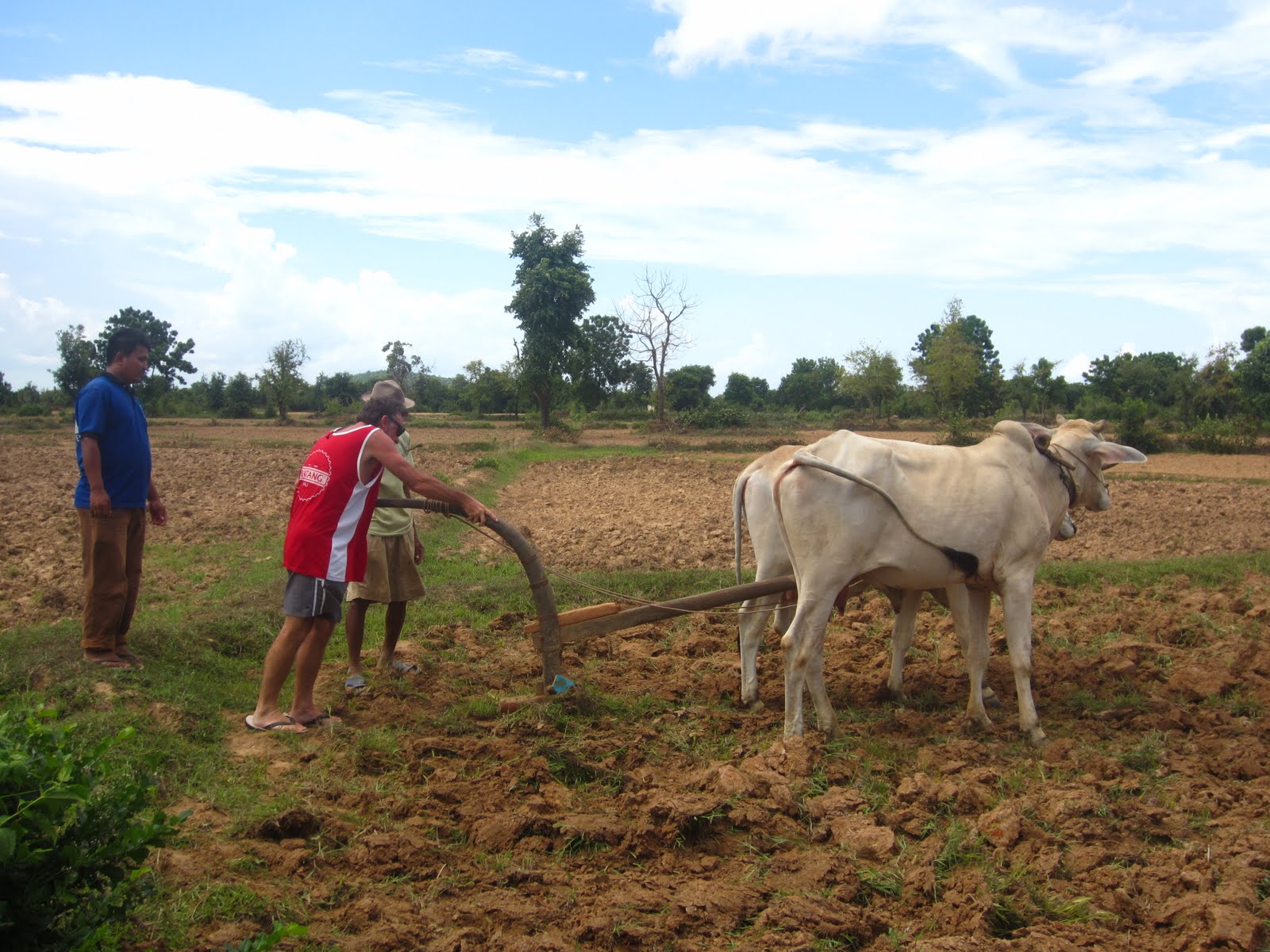
Lending a helping?? hand

On we went to our next destination while sampling some lotus fruit Kim collected from a roadside lotus pond, quite nice, the fruit pod looks like a shower rose. We decided to hire the service of 2 motorbikes with drivers/guides to ferry us up and down the 1km steep hill track to a temple and cave (known as the killing cave) which is where a lot of local people and monks were murdered by the Khmer Rouge and their bodies dumped down a cliff face which leads into the cave, not a pretty sight and again another reminder of man’s inhumanity. The view from the top of the surrounding paddy fields and hills was stunning.
The view from Sailing Boat mountain, the story behind the name ties in with the disappearing stick.
Off we go to the capitol Phnom Penh, another bus trip another adventure; this one was only a 2 rice stop trip so quite bearable and our front row seats gave us a bird’s eye view of the traffic chaos that unfolded before us. The buses drive down the centre of a two lane road playing chicken with each other, whoever is the biggest physically claims right of way with the smaller pushing back into the right-hand lane with total disregard for anything smaller again, motorbikes can easily be forced off the road altogether. Our tolerance to buses is obviously improving as we are now becoming quite adept to tuning off to the Asian love songs which are played at full volume incessantly for the duration of the journey, if we ever show signs of enjoyment please shoot us quickly and relieve our misery.
The view from our balcony in Phnom Penh you can see the Mekong junction at the end of the spit which is now covered with water


The room we found in Phnom Penh was fantastic and the staff were great, it was where all the best restaurants were located and had uninterrupted views across the road to the river and boardwalk, we were almost directly opposite the river junction where the Mekong River meets the Tonle Sap River causing it to flow backwards upstream towards the lake. The boardwalk is a narrow version of the Strand with heaps of people and activity every evening but as you can see not in the mornings. It was great to just sit back on our balcony with a beer and/or rum and watch the goings-on. One afternoon we looked up and there was an elephant walking past, we could have jumped on its back.

Surprisingly it works
While here we checked out the sights, firstly the” killing fields” and the Khmer Rouge prison S21 where the worst of the atrocities took place between 1975 and 1978, unfortunately because of local political interference and international embarrassment at what happened the perpetrators have not and most probably won’t ever be convicted for their obvious involvement in the crimes committed against the Cambodian people. The government here is intentionally keeping the people uneducated to prevent any opposition forming, so that the people’s only focus is survival by whatever means possible. Despite the severe hardship they face they are by far the best people we have met throughout Asia,even with a lack of education English is widely spoken and understood so communication is easier.
S21 prison was a school which they closed, the cells are 2m long x 800mm wide and each prisoner was chained to a steel ring grouted into the floor within the cell. Only 7 out of 17,000 survived.
Next we went to the Royal Palace which is a smaller version of the Thai Palace although it still possesses many ancient and modern artefacts and buildings. The royal family here are predominantly figure heads only, having very little to do with the running of the country, same same as most other monarchies.
The Silver Pagoda (home of the Emerald Buddha) at the Royal Palace, the floor is covered in sterling silver tiles each weighing 1.5kg 
We also paid a visit to the local “Kingdom Brewery”which is a private company that brews a local pilsener using German ingredients, it’s called Leopard. We had a personalised tour with the brew master who guided us through the whole production process and then helped us polish of a few, well, OK a lot of samples including an as yet unreleased dark ale which was bewy lubberly!!
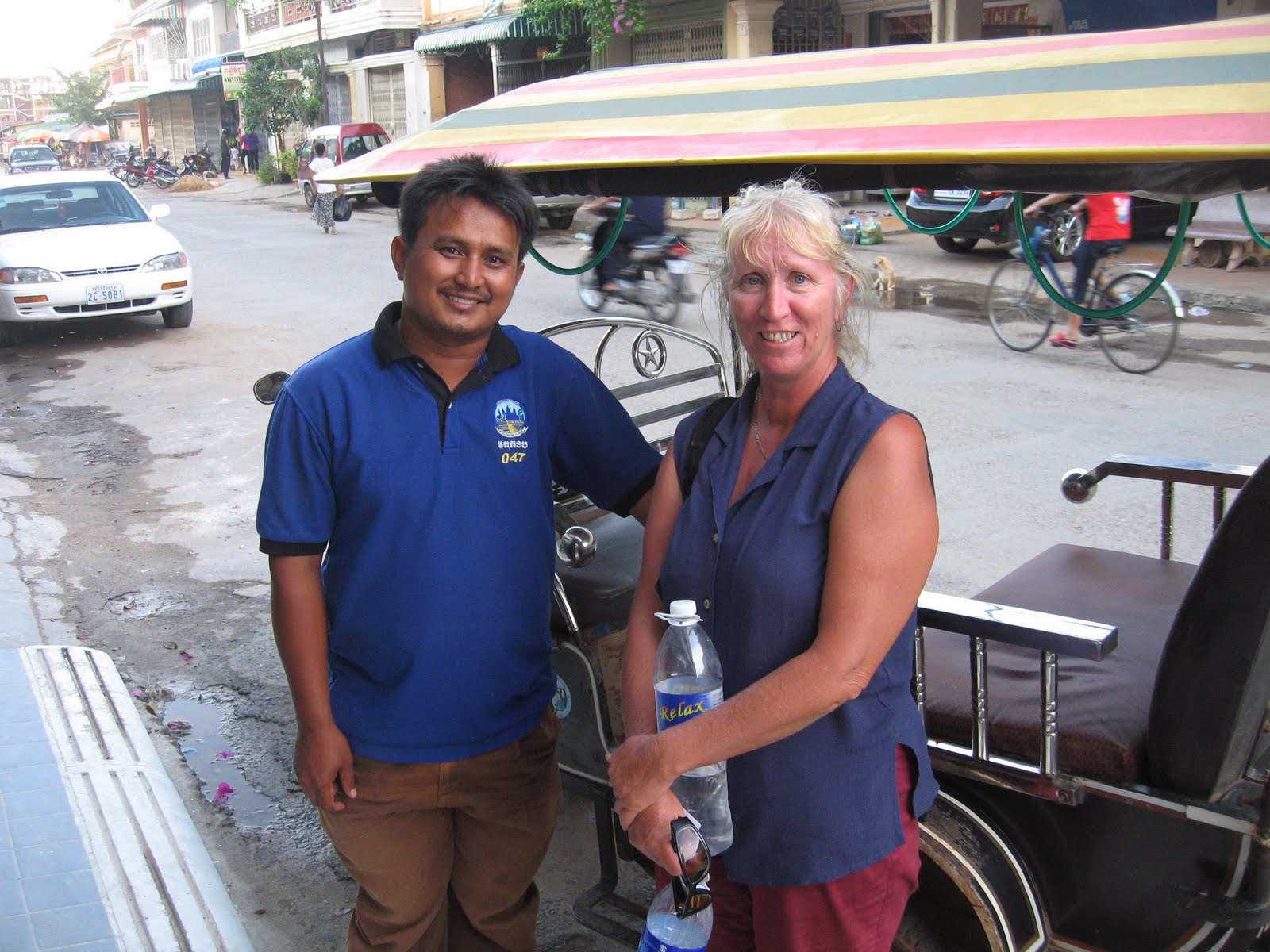
 
Kim our driver in Battambang hopes to make it to OZ one day
Well we have certainly enjoyed our stay in Cambodia and could easily spend more time here, but have decided to move on to beat the impending wet season. In the week we have been here in Phnom Penh the river has already risen 1 meter and every day the clouds get thicker and darker, luckily for us however there’s been no rain.We will certainly return and check out the provinces further south and west or just sit back anywhere in this country and enjoy the local people, food and cheap beer. Its certainly worth a visit if you ever get the chance.


Bye for now,
Beers and Cheers from the Kingdom Brewery tap room bar
J&J

Tuesday, 14 June 2011

Cambodia - "Same Same but Better"

Hi from lovely Cambodia,
Well what a relief, to be in another country with kind and friendly people. The Cambodian people are probably the poorest in SE Asia due mainly to the numerous wars and the Khmer Rouge reign during the 70’s but they take the cake so far for being the best people we have met. 50% of the population is under 16 years of age. The kids yell out “hello” to us all day long where ever we go. They all learn English at school and love to practice whenever they get the opportunity. Everyone we have met has bent over backwards to help and cater to our needs, which are pretty basic compared to many tourists. So far (touch wood) we haven’t encountered a single scammer, even the tuktuk drivers are polite and honest. All the regular buses here are equal to the VIP buses in Laos so that’s a relief even though our journeys now are only 5-6hrs max, they are comfortable and our luggage is loaded inside the bus on seats rather than in the luggage compartments with the chickens or thrown on the roof.
View of the Mekong from our hotel room in Stung Treng
Our first stop in Cambodia was just across the border in Stung Treng, situated on the Southern bank of the Tonle San a tributary of the Mekong River. There is little if anything interesting here other than the people, but the hotel was very nice with a view out to the river and it provided an opportunity to taste the Khmer food and local beer. The food is better than Laos and the beer comparable with many more brands available, albeit slightly more expensive.
Local bed delivery service fresh from the factory
The next day we were off to Kampong Cham a larger town further down the Mekong River with a massive big bridge which was built in 2001. Australia has been responsible for the construction of many bridges in Cambodia replacing the pathetic ones (mostly single laned) provided by the French during their extended stay early last century. Again we booked into a riverfront hotel but unfortunately couldn’t get a room with a view, surprisingly for this time of the year all were full, in fact we could only stay for 2 nights as all the rooms were taken for an upcoming conference. We hired a motorbike from a local restaurant we favoured and took off to see the sights, a rubber processing plant which was fascinating to watch the whole process, plenty of temples and a couple of old monasteries full of monks ranging from the very young to the very old. These were intermixed with local villages situated along the Mekong and its tributaries. Most of the people still live in bamboo houses high-set so that they remain dry when the floods come. One of the shrines (stupa) we visited was full of human skulls and bones a legacy from the Pol Pot regime 1975 – 1979 where up to 3 million people were massacred and scattered in mass graves, this is one location of the many infamous killing fields.
A sad reminder of human cruelty


Well its goodbye to the Mekong for a while as we head west around the northern side of Tonle Sap, the largest fresh water lake in SE Asia and on to Siem Reap the tourist centre which services the ancient Angkor City built between 800AD and 1400AD. The ancient city is on par with the Egyptian Pyramids for its sheer size and bewildering construction in such primitive times. The Angkor Empire reigned over SE Asia for 600 years before the Thais and Chinese eroded their border defences. In that time they built a huge hydraulic water supply system to cultivate crops and massive religious (Buddhist and Hindu) temples within gigantic moated and walled confinements.
A giant cottonwood tree reclaiming Ta Prohm
The buildings and perimeter walls were generally constructed of laterite (volcanic rock) faced with intricately carved sandstone. The sandstone was rafted down the river 50 km from the quarry. The cities housed well in excess of 1 million people but only the gods could live in the stone buildings.
Same Same but Different
The most picturesque is Ta Prohm with many of the buildings and ruins overgrown with massive fig trees that appear to have sprouted on top of the stonework, along with the green moss and general disarray you could think you’d witnessed the world after the demise of mankind.

A giant fig reclaiming Ta Prohm
We spent 3 days touring the ruins ferried around by our favourite Tuktuk driver/guide Chhet, who we were able to choose out of the mass of want to be’s the day we arrived at the Siem Reap bus station.  His was the biggest and best looking Tuktuk, but like all the others totally devoid of anything resembling suspension.
Angkor Wat the biggest best preserved of all temples

We have tried to photograph the buildings and ruins the best we can however none of the photos do it justice as they don’t capture the feeling of total awe you get while there. It truly is a TOTALLY AWESOME!!! place. Angkor Wat, one of the last built and best preserved, can best be described as a piece of artwork as the perimeter galleries (about 1km in length) are lined with floor to roof carved sandstone panels depicting  battles between the gods and demons and other ancient battles. All the doorways have carvings of various types depicting significant religious events and characters which are only understood by the monks and historians. The highest towers are still a functioning Buddhist temple and require ‘appropriate dress’ to enter ie: shoulders and knees covered. The stairs leading to the top are very steep 4:1 representing the difficulty for one to reach the gods.
Same Same but Closer
The local hawkers (from the age of 5 years) have a saying which covers every conceivable option in every language when they ask (beg) you to buy their wares (silk weavings, T shirts, postcards even bottles of water) even if you already have one of each they will reply to us SAME SAME BUT DIFFERENT or BETTER, needless to say their bartering skills are commendable, a great challenge, and a lot of fun.  We did manage to get a few bargains helped by the fact that the tourist season is coming to a close.
Checking quality before the haggle starts 

The wet season is starting to show its presence with lightning and thunder storms every afternoon since arriving in Cambodia so we will no doubt have to suffer getting wet a few times as we continue our adventure.


Bye for now
Beers and Cheers (in this case Cambodian Angkor Premium a loverly drop)
J&J

Sunday, 5 June 2011

Sabaai-dii (hello) from Laos


Back in familiar territory again on the banks of the Mekong River but in a more upmarket hotel than our last visit to Vientiane, similar location but no self- seeking hotel staff. In this country you’re an instant millionaire as AU$1 = 8,500kip. Just like good old Indonesia. So being multi-millionaires we stayed 3 nights and took in all the sights, mostly temples, monuments, grandiose French colonial buildings and the Lao version of the Arc de Triumph (photo in last blog). The best part of Vientiane is the cheap Beerlao (AU$1 per longneck), the food and walking through the parks along the Mekong soaking up the peace and quiet; it’s the most laid back capital city in the world.


One of the many monuments in Vientiane

Heading southeast on another “VIP” bus 6hrs later and 300km from Vientiane we reach our next destination Tha Khaek (pronounced Ta Kek) known for its limestone caves. We decided to upgrade our accommodation from the original selection as it’s necessary to read between the lines of the Lonely Planet descriptions. The writers would make good real estate salespeople. Simply it’s a matter of getting what you pay for. Anything below AU$20/night is really not good, unless you’re a budget driven YOUNG masochistic backpacker. We hired a bike the first day and did a circuit of the local caves which was very interesting, most are sacred and full of shrines and Buddha images. Getting to them was no easy feat as we had to drive on the right-hand side of the road looking for non-existent signs, navigate across a creek bed full of water, rutted dirt roads full of potholes and rocks, narrow wooden bridges with planks missing, darting chooks and the forever curious water buffaloes strolling across the road. At one cave we found a local who said he would guide us along the path which we discovered had been camouflaged with broken branches, by him no doubt, very enterprising person. The cave was quite large but restricted part way in by a deep creek crossing which I couldn’t cross without getting wet. John said not to bother but the guide was insistent and tried to carry me but fell and cut his foot, now wishing he hadn’t covered the track and led us in although 15,000kip richer he was probably glad to see us on our way.

View from one of the caves looking out onto unploughed paddy fields

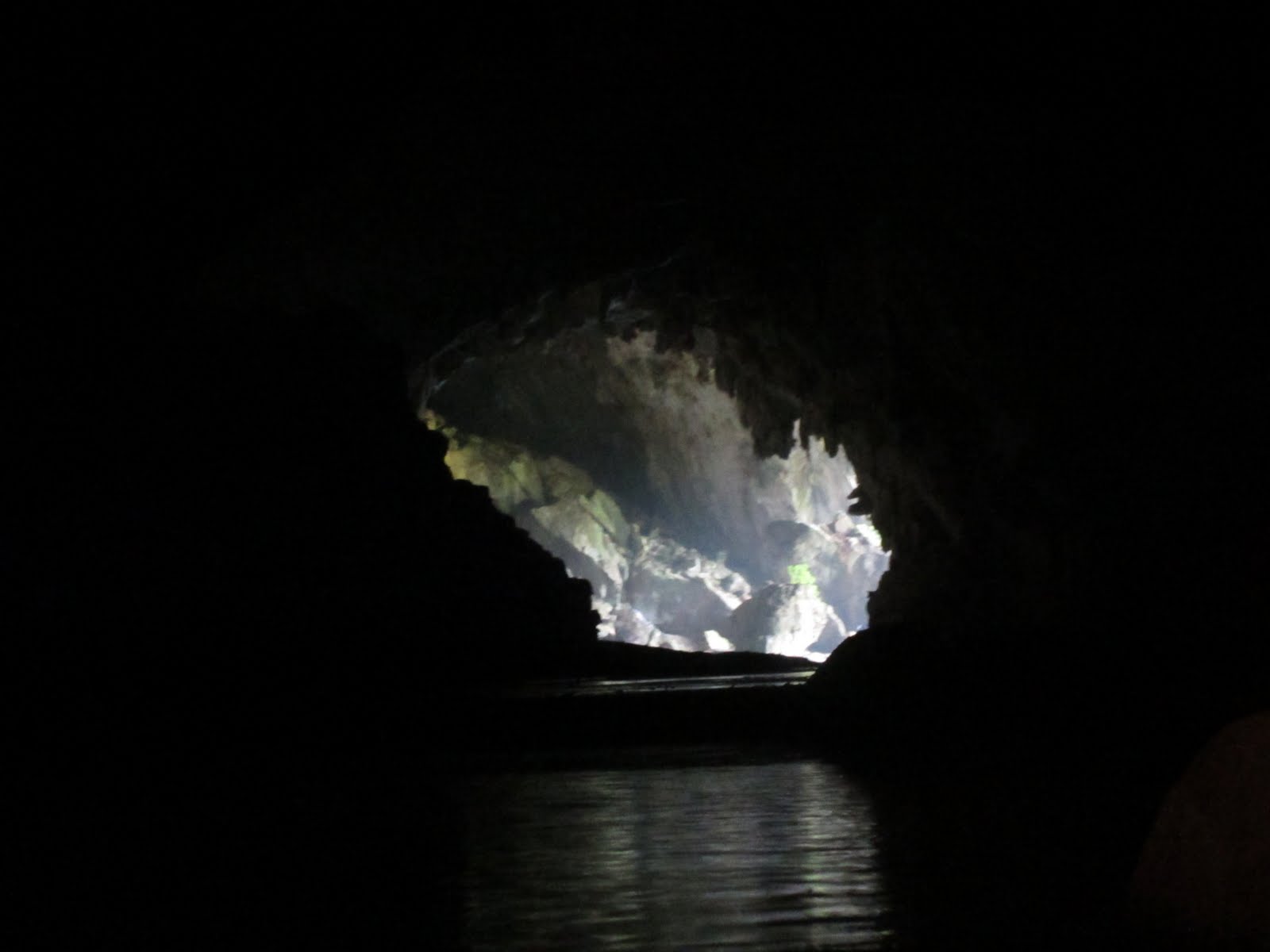
The next day we headed off on a guided tour of the legendary Khong Lo cave, 120km northeast of Tha Khaek in a minibus, with our “English speaking” guide and separate driver (lunatic). The cave is 7.5km long running through a single limestone mountain and is navigable the whole way in a longtail (long skinny canoe with an engine and external drive shaft attached to the stern). There’s a couple of shallow spots and 1 small set of rapids inside which makes it very exhilarating. It’s pitch black the full length except the largest gallery which is lit with various coloured lights. This and other galleries are up to 100ft high and contain some incredible calcium features (stalactites and stalagmites). The trip through takes about 1.5hrs, the longtail skipper and the bowman have spotlights to guide the way.  The cave is closed from the end of June for 3 months as the flow of water is so great from the monsoon rains that it becomes too dangerous.

The lit gallery in cave


Exiting the other end after 7.5km

 
Next day we head off again, unfortunately on a local bus this time, headed for Pakse and 380km further south. Much better than the Chinese buses so we both take up a double seat each and sit back to “enjoy” the trip. Two hours later we arrive in Savannakhet and are pleasantly surprised by the quality of the bus station toilets, so impressed John paid to go twice in the hour long lunch break. Five minutes down the road after the break but still in town the bus stops virtually in the middle of the road and is promptly turned into a tabletop truck taking delivery of 10 new motorbikes which are singularly manhandled up the side and lashed to the roof. Without the photos no one would believe it. Still scratching our heads as to why they weren’t delivered and loaded at the bus station, 2hrs has gone by and we’ve travelled about 3km????? . Finally arrive in Pakse at 1900 in the dark again and travel the extra 8km to town from the bus station in a tuk tuk. We have to direct him as he does not know our hotel even though it’s in the main street. He stops at a friend’s hotel and tries to ditch us there, we ask his friend where our hotel is and he doesn’t know either. I look up while John is talking with the men and luckily see our hotel sign right next door where it should have been. The driver and his friend then ask us to pay 5 times the going rate for the trip from the bus station saying that we chartered his tuk tuk, this then ends in an argument, John offers ¼ his price and says the offer will decrease every time he says no. He took it and we left and checked in next door. Again arriving at night leaves us very vulnerable to these unsavoury characters.

 Pakse is a very uninteresting town and really only a stop to access the 4000 islands further south.  The entrance to Pakse from the north is via a single lane bridge donated by the French over 100 years ago. Perhaps they thought the town so boring that once out of it people would not want to return. We found a really good Indian restaurant across the road from the hotel with excellent spicy food and cheap beerlao, that’s all we need to keep us happy. Accommodation was cheap and nasty but central; the upmarket hotels were miles away from town.

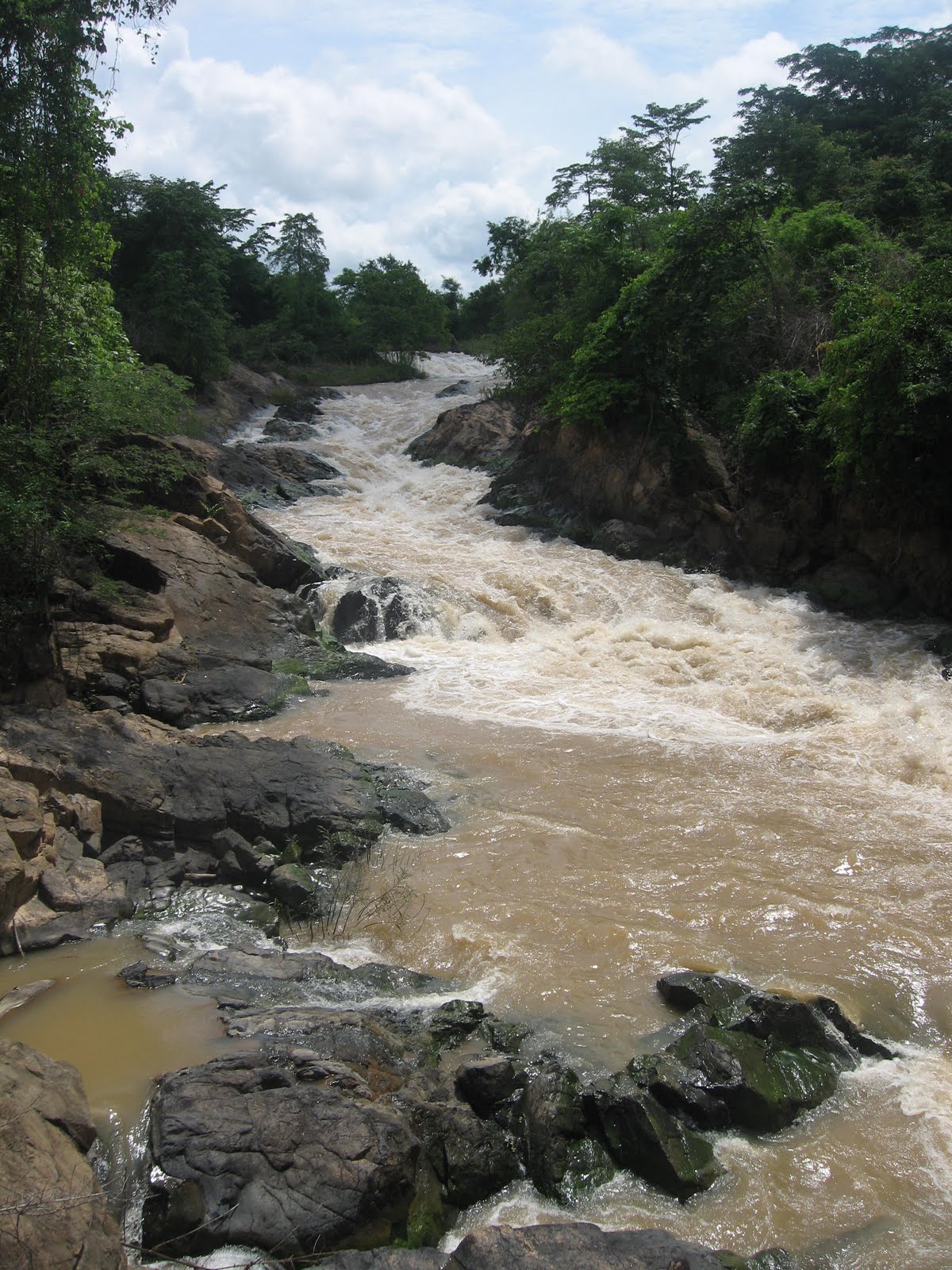
2 nights in Pakse was enough so we booked a minibus and headed south to Don Khong Island the largest of the 4000 islands group. This group of islands creates a separation in the Mekong River into many fast flowing waterways  and because of underlying rock structures waterfalls have developed, one of which is the largest (by water volume) in Southeast Asia (photo below). The waterfalls also prevent access by boat from the south, from the north is ok providing you stop before the waterfalls which has been a problem for some locals in the past apparently. There are plans in the pipeline to build a dam across this section of the Mekong which will no doubt have a disastrous effect on the river system and the people who live off it.

The Buffalo are no longer beasts of burden since the introduction of the so called tractors instead they are kept for meat

To get to Don Khong one must get dropped off at the ferry (longtail) jetty on the mainland after a 2hr minibus trip then negotiate a fare across 1km of river. The trip took about 10min while the negotiations at least 30min, it was our 3rd longtail skipper who finally agreed a price which was still double what we had been informed in Pakse. The 1st wanted too much, the 2nd wanted payment up front. John started to sing “don’t pay the ferryman till he gets you to the other side” I think the 3rd one felt sorry for us. Actually it only cost us AU$1 each but that’s not the point.


A couple of the local kids happy for a photo snap

Don Khong is a wonderfully quiet island, we took a very spacious room at the most upmarket hotel, all other accommodation was in guesthouses which were very basic. The island was empty of tourists, we saw about a dozen whites (fa rangs) in the 4 days we stayed. From now till November is very quiet and rooms are very negotiable. We hired another motorbike for the day and did a full circumnavigation of the island, which only took 4hrs.


A local restaurant with water views

The island is full of rice paddies at various stages of cultivation, mango trees full of fruit and heaps of domestic farm animals that roam around everywhere. It was like being on one gigantic farm, the only farm fences were temporary ones to keep the animals out of the rice. We wondered how they know who owns what. These people are so laid back they probably don’t care.  Again we found a good restaurant with very friendly staff although the beer was more expensive AU$1.20 each, ah well, island prices I guess.


The Khonphasoy Waterfall has claimed the lives of 5 fa rangs so far and injured many others


Off again on yet another trip along the Mekong this time 1.5 hrs downstream in a longtail to Don Det Island and Don Khon Island which are part of the 4000 island group and joined by an old defunct French built railway line and bridge which served as a means to transport goods from the lower level of the waterfalls to the upper levels. It is in the lower Mekong where the rare Irrawaddy dolphin live. A dolphin that lives in fresh water although the numbers have dwindled dramatically due to modern fishing techniques. Another bike rental and its off again circumnavigating the 2 islands checking out the waterfalls and farmlands. We thought about a dolphin tour in a longtail but after speaking to a local fisherman we were advised that it's better in Cambodia.
Well that's about all for this blog, tomorrow we're off to Cambodia, another country another set of challenges no doubt.
Beers and Cheers (or in this case Myers's Rum)


J&J


Wednesday, 25 May 2011

7 Days in China

Well what a week it’s been for a while there we thought that this blog would not make the net. China does not permit blogging and all sites are blocked. Have inserted some photos from the Mekong trip which we didn't have in time for the last blog. Our experiences in China over the past week may appear very negative and perhaps our naivety shows through, however it has been such a surprise, disappointment and contrast to the rest of Asia we have experienced so far.  China is a progressive modern country economically and industrially but socially is way behind the rest of SE Asia. They are very insular, rude and appear to be ignorant of anything outside their country other than commercial brands and designer clothes even if the spelling is different. Below is our 7 day (intended 57 days) in China.
John inspecting the quality of work in the village


We were hoping to take the slow boat to China via the Mekong River, again, but due to a lack of numbers (now quite understandable) the service was cancelled. Instead we caught the SLOW bus to China from Huay Xia (Laos) to Jinghong. Thinking that the buses couldn’t get any worse than the one to Luang Prabang we were unpleasantly surprised to see what our 12hr journey entailed. Crossing the border into China and the scenery were the only pleasures of the day. Having to tolerate constant spewing and spitting the entire trip we finally arrived in Jinghong on dark in the pouring rain. The nightmare continued, finding that no-one could speak or understand a single word of English and all signs other than a few street signs were in Chinese script. We caught a tuktuk to nowhere as he couldn’t find our accommodation even though we showed him the name in Chinese script (Lonely Planet has Chinese script for everything and place in the book). We began roaming the streets and eventually found a place to stay, with intentions of securing better accommodation the next day. The room was big and comfortable but the bathroom had a squat toilet and a very unpleasant odour. All communication was done with hand signals. Our next day was sunny and we explored the main streets, organised bus tickets to Kunming and organised a phone card with the help of a food stall young lady who spoke perfect English, she had been to university and when asked why she was working a food stall her reply was she didn’t wish to be a white collar worker. The phone card proved to be a waste of money as the balance check was spoken in Chinese unlike all other cards so far which display the value on the screen, again lack of basic communications did not help. Found a couple of decent restaurants however the food was not a match on Thailand’s.


Water Buffalo along the Mekong River

Arrived at the bus station the next day early hoping the next stage would be better. After getting on the bus (thankfully much better than the last), we were each handed a plastic bag, thinking it was for our rubbish (as one would). How wrong we were!! Instead they were for people to spit in, men and women alike! A filthy, dirty Chinese habit that must predate western history.  As the 10hr trip unfolded John began to feel the effects of a Chinese belly upset, cause unknown. About an hour into the trip the bus was pulled over by police in army uniform, one sporting an AK47 assault rifle. They boarded the bus and intimidatingly demanded identification from everyone and then after some bickering everyone was ordered off the bus except us, whereby luggage was removed and searched thoroughly. John decided to get off to watch proceedings but decided it wise not to photograph, he did however confirm which luggage belonged to us which they declined to search. This was lucky as John’s bag was full of drugs (prescription of course!!!). This whole procedure took about an hour before the bus was allowed to move on.  The trip continued, the lunch/toilet stop was a memorable experience, unfortunately, and is an entire story on its own (we hear that tourists describe toilet experiences in China like war veterans discuss battles). We arrived at Kunming an hour before dark and eventually found out that the bus stopped approx 20+ km out of town. From here we had to catch a local bus, thanks to some very basic communications and again hand signals with a security guard. We finally arrived in the city centre and by this time John was feeling much worse for wear, vowing never to catch another Chinese bus again, we then headed for the first decent hotel we could find which just happened to be the Marriot, expensive but very nice after our ordeal. Surprisingly, even at the Marriot, English is extremely basic and at the information/ tourist desk non-existent.
Taste testing the local rice whiskey with our guide Kee in foreground

After some R&R and further investigations into getting around China we felt that we were constantly running into brick walls, frustrated and bewildered by this TOTALLY different Asian country, from our previous experiences we’ve had to date. It seemed fruitless to continue through China on our own so we reluctantly decided to cut and run. In our opinion the only ways to see China is on an organised tour or hire your own Chinese guide for the duration. You can’t even arrange your own transport other than buses and trains, you must go through an agent and pay at least twice the local rate an issue not raised in Lonely Planet book. After two days at the Marriot we headed down to the accommodation we originally planned to stay (recommended by Lonely Planet), it was very comfortable and cost effective.
Kunming, China. A small provincial city

We decided to fly back to Vientiane in Laos where we could continue on our journey but in the reverse direction. It took another 3 days before we could catch a flight so we had to fill in some time. Because of the language barrier and size of Kunming (size of Brisbane and approx  6 million people) it was impossible to visit any sights on our own so a highlight was a visit to Carrefour (French supermarket chain worldwide). Unlike all others we had visited in SE Asia this one stocked some  local delicacies such as live toads, tortoises and what looked like skinned cats dead thankfully in the poultry section. Cleaning was very thorough in the meat and vegetable section as we witnessed the same mop being used to not only clean the floor but cutting benches as well. No wonder I was sick still and the locals are always coughing and spitting.
Fancy a cuppa? Tea bundles in China

Everyone is used to beautiful Chinese food around the world, however this is not the case in Kunming, Jinghong or probably the whole of China, surprisingly its bland, tasteless and meat if any very dubious. One dish we had was ordered from pictures as no English and it looked like chillied chicken. It was chicken but not the flesh it was chicken stomachs sliced similar to the way we dissected them in Biology classes. Chicken feet dishes were also very popular. Other dishes were inedible. Thankfully the rice was ok.
What a contrast the old and new of China

Besides the hazards of eating in China, walking down the footpath is dangerous as it’s where the electric motorcycles are allowed to traverse whenever they feel like moving of the road to avoid the traffic jams. You can’t hear them approach and when close they beep their horns and head straight for you, making you leap out of the way.

Well the day finally arrived so it was up early to avoid the worst of the traffic jams. We headed to reception to check out, collect our key deposit and arrange a taxi for the airport. When asked if she could call us a taxi the receptionist said in chinglish it was not hotel policy and that we could go out to the front street and hail one. John said it was Monday morning and raining it would be unlikely that any taxi would stop for a couple of wet foreigners with luggage. She just smiled and turned her back. Luckily a taxi turned up that minute at the entry to drop of a local guest. We just about flew in through the doors and indicated the airport on our map. No way was he leaving without us. Off we went and 30 minutes later stage 1 of our escape was complete.
Exit stage left

Stage 2 was completed after an airport bus trip to a distant part of the runway as Laos Airways is not permitted direct access to the terminal. Once in the plane the boot was on the other foot and we took great pleasure in seeing the frustration of the Chinese passengers who could not fill in their Laos arrival paperwork as it was in Lao and English. We were welcomed with a smile and the best flight food with endless coffee we have ever experienced.
Victory Monument  Vientiane, Laos
Know as the vertical runway as built with concrete the U.S gave Laos to build an airport in 1969

Arriving in Vientiane 2 hrs later we headed for our hotel, booked in then headed to the closest bar about 50m away and drank  Beerlao for the rest of the afternoon, chatted to some locals and tourists. Great drop and as good as Bingtang (Indonesian beer).

We now feel relaxed and looking forward to continuing our adventure albeit based on a reduced schedule which could allow for either increasing our stays or adventuring to other places and countries.


                                      Cheers and Beers for now (in this case very welcomed Beerlao)
                                                                                        J&J


Monday, 16 May 2011

Kanchanaburi


  Kanchanaburi, is situated 80km NW Bangkok and was reached by train taking about 3 hours. We think it was a 2nd class train as seats were still padded and reasonably comfortable. Very full though and throughout the trip we had hawkers going up and down the aisles selling beer, soft drink and all types of different food at inflated prices naturally. Fascinating to watch the daily goings on of the Thai people. Arrived at our destination to the inevitable taxi/tuk tuk drivers but we knew we had only a short walk to our hotel and set off, only to find when we got there that (no have) again!!! But this time it was the wrong hotel. Apparently the owner of our hotel has several in and around this area (quite an entrepreneur) and once the problem was sorted a tuk tuk (one which we waved away earlier) arrived to pick us up and take us to the correct “hotel” (which they paid for!). A common mistake we understand and one that could easily be rectified by the strategic placement of a couple of signs. Our room is one of several constructed on a floating pontoon and sitting on the River Kwai (pronounced square without the “s”).  Quite pleasant watching the water flow by and the longtail boats zoom up and down, while having a beer on our little balcony. Just like home.

Our home for 3 nights on the River Kwai

Once settled in we headed for the Thai-Burma Railway Centre Museum just up the road. A very moving and informative experience covering the construction of the railway, treatment of the POW’S and what happened after construction. No photos were allowed unfortunately. Across the road is the Allied War Cemetery where over 6,500 POW’s are buried from Britain, Australia and Netherlands. It’s beautifully maintained and due to the fact that Anzac Day was only a few  weeks ago there were still Aussie flags, red poppies and wreaths around the cemetery. Very  touching.


Allied War Cemetery
 
Hellfire Pass

Next day we were up early catching the train to Nam Tok, 50km NW now the end of the upgraded?? original railway track. We crossed the legendary River Kwai bridge and had a very enjoyable 2hr roller coaster thrill ride before disembarking and catching a local bus the final 30km to Hellfire Pass. Just as we arrived at the Museum the rain that had been threatening all morning decided to fall. Oh well, just made the experience more realistic. The museum is quite informative, but it’s the walk along the remains of the railway track that really touch you and it is quite gut wrenching to try and imagine what the PoW’s went through seeing the terrain they had to toil in. And what makes it even more saddening is that the scenery is beautiful with the hills in the distance dividing Thailand from Myanmar (Burma). The greatest irony however is that so many men died from starvation in one of the most fertile valleys on the planet.


The original bridge over river Kwai still exists after the bombing, but the central section has been replaced. We travelled over this on the way to Hellfire Pass by train      and walked over it the next day. The original bridge was all curved sections. 
 Two days later after our stay in Kanchanaburi it was back to Bangkok by bus and taxi to collect our passports which we left at the Chinese Embassy for our 30 day visa to China which hopefully can be extended to 60 days otherwise another diversion maybe necessary. If you have ever heard horrible stories about Bangkok taxi drivers believe me they are all true. From Bangkok it was another overnight train to Nong Kai in the NE province of Thailand and 2 tuk tuks across the border to Vientiane in Laos where we have solved our shortened Thai visa dilemma. Our first choice to solve the problem was thwarted when we couldn’t get confirmation from the Thai immigration office that the border crossing to Myanmar (Burma) at Mae Sot would be open for a quick visa run on the way up to Chiang Mai (it and the others have been closed on and off due to constant border clashes and refugee problems). Getting into and out of Laos is easy with a 30 day VOA .


An adopted local who lived in our roof we named Kwai


The unwanted neighbour that tried to eat our Kwai

Without prebooking accommodation in Vientiane we winged it and found a pleasant guesthouse on the Mekong riverfront and made inquiries about a 2 day river trip up the Mekong from Luang Prabang to Huay Xia (approx 400km) which joins the northern Thai border and allows us to re-enter Thailand to complete our intended itinerary and then on into China via the Mekong again. We booked the trip at 1700 on 12th May and had to board the boat at 0645 on the 14th which meant securing tickets to Luang Prabang a 12hr bus trip for Friday 13th. We tried pre-booking tickets on the 0800 VIP bus with our guesthouse manager but found his “bus no have, must catch different bus” reply very deceptive, so decided to wing it and just turn up at 0630. After much haggling with several tuk tuk drivers the next morning we arrived at the bus station and promptly bought 2 tickets for the so called full 0800 VIP bus. Another attempted con job.

Our 40m long river boat on the mighty Mekong which we shared with 4 other couples, 2 guides and 4 crew

2 fantastic days cruising up the Mekong River and a night at an ecolodge we arrived at Huay Xai. After several anxious phone calls initiated by concerns raised by a fellow river passenger we found out  that the Mekong ferry from Thailand to China we intend taking could be cancelled due to a lack of numbers so if we cross the border into Thailand tomorrow as intended we may get stuck and have to go all the way back to Bangkok and fly into China. No way are we doing that!!
Another alternative (number 3) and current favourite is to take 2 local buses (best travelled with blindfolds) up through the mountains to a Laos/China border crossing which we hope is still open. Northern Thailand will have to wait now till we return to Thailand in September. 

We have posted this blog without a definite destination tomorrow (so much for pre-planning) and may not have internet for a while so watch this space and all will be revealed eventually. If this blog is a bit messy it's because we rushed it.


                          Cheers and Beers ( in this case Chang Beer at Kanchanaburi)  bye for now

                                                                            J&J